
At 70, Bruce Willis Faces His Hardest Chapter: The Emotional Family Farewell No One Was Prepared For ”
The sun had barely risen when the Willis household began filling with footsteps that carried the weight of unspoken goodbyes.

Each arrival was quiet, almost hesitant, as though crossing the threshold meant acknowledging a truth they had been trying to resist.
Bruce, now 70 in this fictionalized retelling, sat in his favorite chair near the window, the soft light outlining the familiar silhouette that audiences around the world once associated with indestructibility.
Yet in the stillness of that morning, he appeared suspended between worlds—part memory, part presence, part echo of the man who once commanded the screen with a single smirk.
His family moved around him with a choreography shaped by love and dread.
Rumer’s hand lingered on the back of the sofa longer than necessary.
Scout paused in the doorway as though gathering courage before stepping closer.

Demi Moore, poised as ever, wore an expression so carefully composed it nearly cracked at the edges.
Their interactions, usually lively and overflowing with warmth, were muted today, shaped by the gravity of watching someone they adored fade into a reality none of them knew how to navigate.
But it was when Emma Heming Willis walked in that the atmosphere shifted completely.
Those present later said her face carried a quiet determination—an acceptance forged not from giving up, but from the kind of love that stands unshaken in the face of heartbreak.
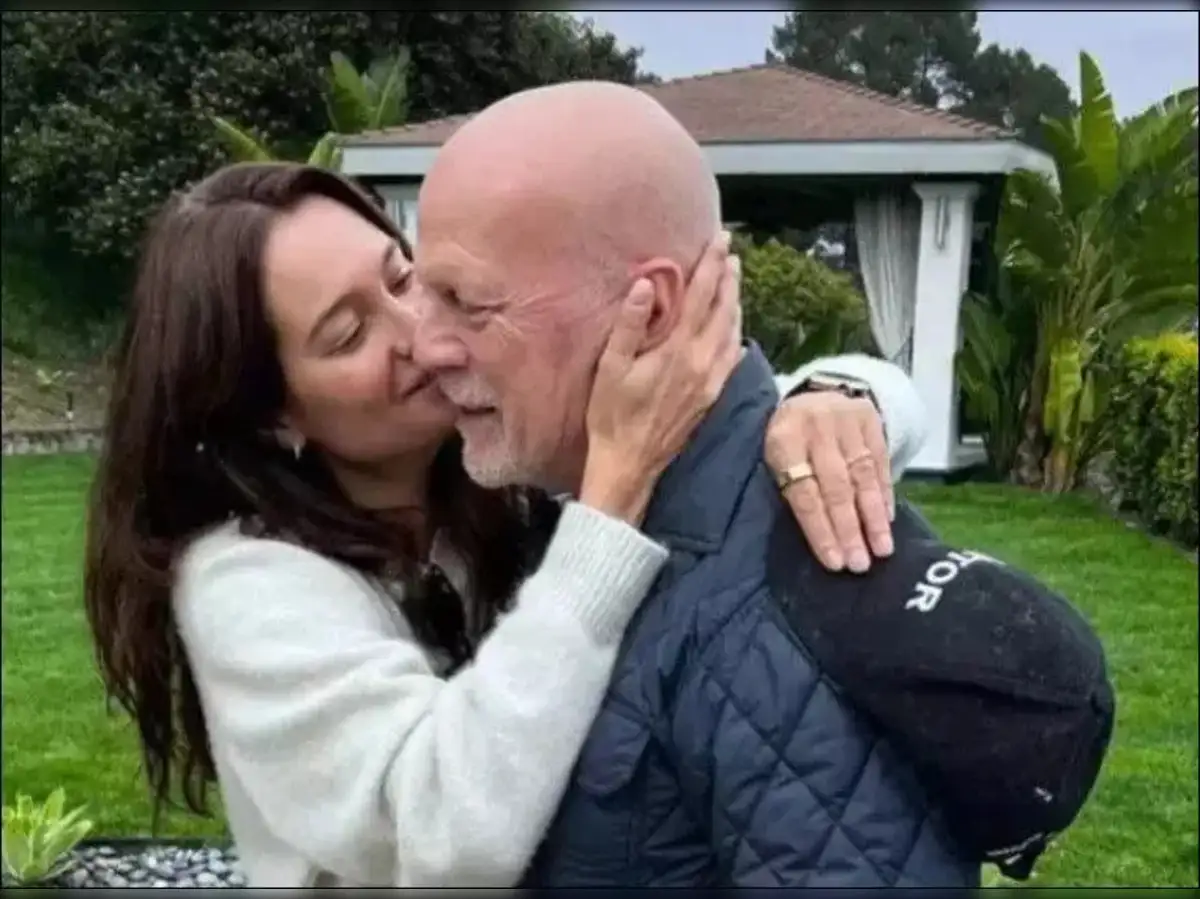
She approached Bruce with the practiced gentleness of someone who had learned to meet him exactly where he was in each fleeting moment.
When she spoke, her voice barely rose above a whisper, yet the room seemed to inhale at her words.
Something about the softness in her tone, the way she reached for his hand, sent a ripple through the family, drawing each of them into a shared silence that felt both sacred and unbearable.
Bruce looked up at her then, his eyes flickering with recognition that came and went like a candle fighting a draft.
For a heartbeat, he smiled—that familiar half-smile that had once launched a thousand movie quotes.

It was enough to break the composure of nearly everyone in the room.
Rumer pressed a trembling hand to her mouth.
Demi blinked rapidly, fighting back tears.
Scout leaned her head against her sister’s shoulder, her breath uneven.
They had prepared themselves for the gradual progression of his diagnosis, for the forgetting, the confusion, the drifting.
But nothing had prepared them for that fleeting moment of clarity, that echo of the man they knew returning just long enough to remind them of everything they were losing.
The silence that followed wrapped around them like a shroud.
It wasn’t the silence of avoidance or denial anymore—it was the silence of realization, the sound of hearts recalibrating around a truth that had finally settled in full.
Even the house seemed to hold its breath.
Outside, the wind brushed softly against the windows, a gentle reminder that the world continued turning, indifferent to the grief unfolding inside.
As the morning stretched on, the family gathered more tightly around Bruce.
They spoke to him—not loudly, not urgently, but softly, weaving stories from the past into a fabric strong enough to hold the moment together.
They talked about movies he barely remembered filming, jokes he once told, Christmas mornings, on-set mishaps, and quiet family rituals that had outlasted fame.
Even when Bruce didn’t respond, they kept speaking, as though anchoring him with memories strong enough to keep him tethered.
At one point, Emma placed a hand on Bruce’s shoulder and said something that no one else could quite hear.
Whatever it was, it stilled him.
He blinked slowly, his expression serene, as though some distant part of him understood the significance of the moment unfolding around him.
Then came the moment that would stay with them—the breathless stillness that would replay in their minds long after.
Bruce turned his head, his eyes finding each of them one by one with a lingering softness.
Whether it was recognition or instinct, no one could say.
But the room, already thick with emotion, seemed to crack open under the weight of that fragile connection.
And then, just as quickly, the moment passed.
The flicker dimmed.
His gaze drifted.
The room settled again into the quiet reality of his condition.
Yet something had changed.
The family, bracing themselves for the worst, realized they were not simply saying goodbye to Bruce—they were saying goodbye to the version of him that had shaped their lives, their childhoods, their memories.
The man they loved was still there, but in fragments, in flashes, in echoes that grew softer with each passing day.
As the sun dipped lower, the house fell into a deeper silence.
Not finality.
Not closure.
But acceptance—a gentle, devastating acknowledgment of the chapter they had entered together.
They stayed by him long after the light faded, unwilling to leave, unwilling to let the moment slip away entirely.
When the day finally ended, they walked out with the same quiet footsteps they had entered with, each carrying their own version of the goodbye they hadn’t wanted to say.
In this fictionalized narrative, Bruce remained in his chair by the window, framed by the last shards of daylight, the silhouette of a man who had once outrun explosions and villains now tenderly held by the love of a family learning how to let go slowly.
The world outside continued unaware, but inside that home, a legend’s final chapter was being written—not in headlines or fanfare, but in whispers, trembling hands, and the kind of silence that only love can forge.