

R.Kelly, the once-celebrated R&B singer turned convicted s*x offender, finds himself at the center of a new legal battle that could reshape the narrative around his incarceration.
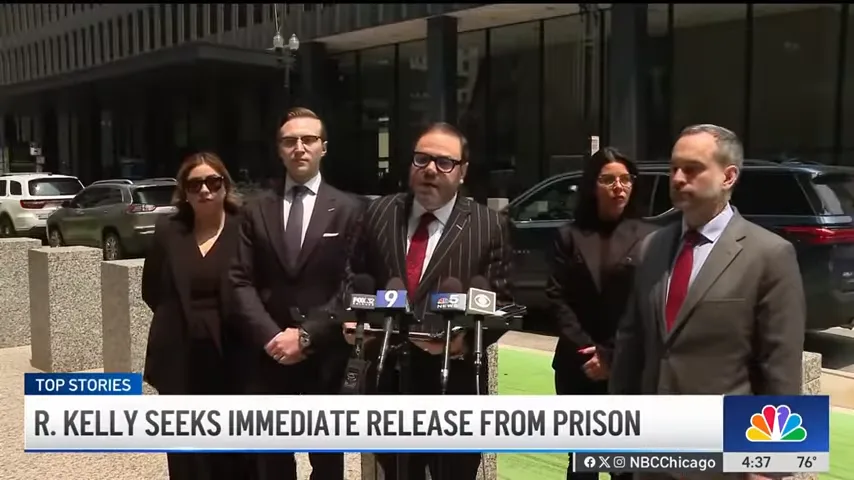
Currently serving a 30-year sentence for multiple counts of child s*xual abuse and exploitation, Kelly’s legal team has filed an emergency motion claiming that the singer’s life is in imminent danger while behind bars.
According to his attorneys, officials within the Bureau of Prisons are allegedly conspiring to have him killed, and they are now seeking his immediate release or, at the very least, extraordinary protection measures.
The motion, filed this week, names two individuals who claim they were approached by correctional officials to carry out an assassination plot against Kelly.
These alleged solicitations, if true, paint a disturbing picture of corruption and malfeasance within the federal prison system.
Kelly’s legal team argues that these purported threats are not merely abstract risks but concrete and imminent dangers, targeting a man who has already been convicted and imprisoned for the most serious of crimes.
Kelly’s attorneys contend that this threat is part of a broader effort to suppress information about the processes that led to his conviction.
In their filing, they claim that the alleged plotters sought to prevent Kelly from exposing what they describe as “corrupt criminal conduct” behind the prosecution and conviction of the singer.
According to the legal team, the purported plan represents an extreme form of interference, attempting to silence a high-profile inmate through violence rather than through the judicial process.
The allegations, if proven, would mark an unprecedented escalation in the already contentious legal saga surrounding Kelly.

Over the years, the singer has faced multiple trials across different jurisdictions, ultimately resulting in convictions for child s*xual abuse, s*xual exploitation of minors, and racketeering.
His crimes, widely publicized and documented in the media, culminated in a 30-year sentence that he began serving in federal custody.
Despite his convictions, Kelly has maintained that he is the victim of a flawed judicial system.
His attorneys argue that irregularities in the investigations, legal maneuvers by prosecutors, and media coverage that predated the trials created an environment in which his right to a fair trial was compromised.
Now, they assert, those same systemic flaws extend into his current incarceration, leaving him vulnerable to potentially lethal threats.
The motion seeks extraordinary relief, asking the court to consider either immediate release or intervention from the highest levels of government, including a presidential pardon.
The legal team frames this request as a matter of life and death, emphasizing the urgent nature of the alleged threats.
In their view, the singer cannot safely remain in federal custody without additional protections, which they argue are currently lacking.
Reports indicate that Kelly has already experienced significant abuse and mistreatment in prison.
His lawyers assert that he has been repeatedly subjected to physical and emotional harm, including situations in which his well-being was neglected or actively endangered.
They argue that these incidents are symptomatic of a larger failure within the prison system to ensure the safety of high-profile inmates, particularly those who are embroiled in controversial or politically sensitive cases.
The emergency motion, filed in federal court, alleges that Kelly is being targeted because he possesses information that could expose wrongdoing among certain individuals within the Bureau of Prisons.
According to his legal team, the singer’s knowledge extends beyond personal grievances and touches on administrative and procedural irregularities that, if revealed, could embarrass or implicate officials responsible for prison oversight.
They argue that the alleged solicitation to harm or kill him is intended to prevent these revelations from coming to light.
Kelly’s situation has sparked intense debate among legal experts and the public alike.
Some observers see the motion as a continuation of the singer’s longstanding attempts to challenge his convictions, while others view it as a legitimate claim of danger in a system where high-profile inmates can be vulnerable to targeted attacks.
Federal prisons, particularly those housing notorious or high-profile individuals, are known to face challenges in maintaining order and protecting inmates from violence, though explicit claims of assassination plots by correctional staff are rare.
The legal motion also highlights a broader discussion about presidential pardons and executive intervention in cases involving serious criminal convictions.
While presidential pardons are constitutionally permitted for federal offenses, they are typically granted sparingly, often in situations involving questions of fairness, excessive sentencing, or new evidence of innocence.
In Kelly’s case, his legal team is framing the request as an urgent measure to save his life rather than a conventional appeal for clemency.
Critics of Kelly’s petition argue that his convictions are the result of thorough investigations and multiple judicial proceedings and that the allegations of a prison assassination plot are speculative and self-serving.
They emphasize that Kelly’s documented history of criminal behavior, particularly against minors, makes him a controversial figure for whom public sympathy is limited.
Nonetheless, the seriousness of the claims has prompted the court to review the motion carefully, weighing the credibility of the alleged threats against the singer’s past convictions and ongoing incarceration.
The emergency motion comes at a time when the broader issues of prison safety and inmate protection are under scrutiny in the United States.
Federal and state facilities face ongoing challenges, including overcrowding, understaffing, and the management of violent or high-profile inmates.
Allegations such as those raised in Kelly’s case underscore the potential vulnerabilities within the system and raise questions about accountability, oversight, and the responsibilities of correctional authorities to protect those in their custody.
Kelly’s legal team is now calling on federal authorities to intervene, asserting that only extraordinary measures can prevent what they describe as an imminent threat to the singer’s life.
The filing emphasizes the urgency of the matter, warning that delays in action could result in irreversible consequences.
They argue that the allegations of solicitation to kill, if accurate, constitute a clear and present danger that must be addressed immediately to preserve human life and uphold the integrity of the justice system.
The case also sheds light on the tensions that can arise when criminal convictions intersect with public perception and celebrity status.
Kelly’s prominence, both as a former musical icon and as a convicted s*x offender, complicates the legal and ethical considerations surrounding his treatment in custody.
While some members of the public view him as undeserving of special protection, his lawyers assert that the law does not allow for inmates to be targeted or harmed regardless of their notoriety or past crimes.
The allegations in the emergency motion are particularly disturbing because they suggest an intentional targeting of an inmate by those charged with ensuring his safety.
If substantiated, the claims would represent a profound breach of trust and legal responsibility on the part of the Bureau of Prisons, an institution designed to safeguard the welfare of all federal inmates.
Such a breach would not only endanger Kelly’s life but could undermine public confidence in the federal prison system as a whole.
At the center of the legal battle is the question of credibility.
Kelly’s attorneys must convince the court that the threats are real, imminent, and not merely speculative.
The court will likely evaluate evidence from the individuals who claim to have been approached to carry out the alleged plot, as well as any corroborating documentation or testimony that supports the claim of danger.

The outcome will depend on the ability of the legal team to demonstrate that the singer’s safety cannot be assured within the existing custodial framework.
Meanwhile, the motion has reignited discussions about Kelly’s broader attempts to challenge his convictions.
Over the years, the singer has pursued appeals, retrials, and petitions for clemency, arguing procedural errors and mismanagement during his prosecution.
The current filing frames the issue not as a question of innocence or guilt, but as a matter of survival in the face of a credible threat.
By doing so, his legal team aims to shift the court’s focus from the controversy of his past crimes to the urgency of protecting a life at risk.
In the coming weeks, the court will examine the evidence and determine whether extraordinary measures are warranted.
This may include transfer to a different facility, enhanced security protocols, or, in the most extreme scenario, consideration of a presidential pardon.
Regardless of the outcome, the case has drawn national attention, highlighting the intersection of celebrity, criminal justice, and inmate safety in an unprecedented way.
For now, R.Kelly remains behind bars, a convicted criminal facing a sentence designed to hold him accountable for his crimes.
But the emergency motion filed by his lawyers has introduced a new dimension to his story: the claim that his life is actively in danger while in custody.
As the court evaluates these allegations, the case continues to unfold, raising questions not only about Kelly’s personal safety but also about the accountability and oversight of the institutions responsible for protecting every inmate under federal law.
In the end, the R.Kelly saga serves as a reminder of the complex realities that surround high-profile criminal cases.
The singer’s history of abuse and exploitation, his high-profile convictions, and now his claims of imminent threats while incarcerated create a narrative that challenges simple judgments.
It underscores the tension between accountability and protection, public perception and legal obligation, and highlights the ongoing need for transparency and integrity within the correctional system.
Whether Kelly’s emergency motion will result in a change to his custody status or even a path toward clemency remains uncertain.
What is clear is that his legal team is raising questions about safety, accountability, and the potential for corruption within the prison system—issues that extend far beyond a single inmate and strike at the very heart of federal custodial responsibilities.
As the case develops, it will continue to draw scrutiny from legal experts, policymakers, and the public, prompting a broader discussion about how justice, safety, and accountability intersect in one of the nation’s most high-profile criminal cases.